by | ARTICLES, BLOG, ECONOMY, FREEDOM, GOVERNMENT, HYPOCRISY, OBAMA, POLITICS, TAXES
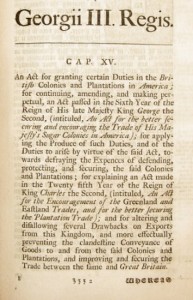
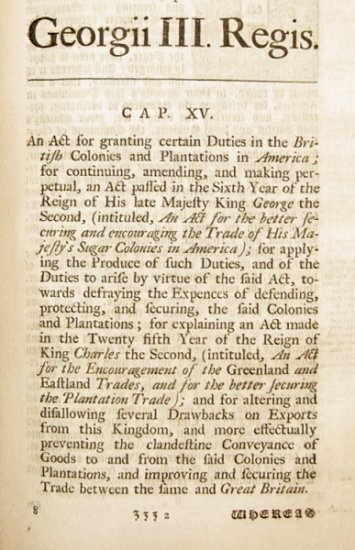
On April 5, 1764, Parliament passed something called “The Sugar Act”, which, interestingly, had another name: “The American Revenue Act”. It was a modification of the 1733 Molasses Act, and it also affected other goods, such as wine and coffee.
The Preamble to this Act states: “it is expedient that new provisions and regulations should be established for improving the revenue of this Kingdom … and … it is just and necessary that a revenue should be raised … for defraying the expenses of defending, protecting, and securing the same.”
The Sugar Act/American Revenue Act, therefore, was a revenue raising measure (and not just a regulation measure), whose revenue was intended to help defray the costs of defending the colonies during the 7 Years War which ended in 1763. Instead, it wreaked havoc in the colonies:
“The situation disrupted the colonial economy by reducing the markets to which the colonies could sell, and the amount of currency available to them for the purchase of British manufactured goods. This act, and the Currency Act, set the stage for the revolt at the imposition of the Stamp Act.”
Fast forward to 2014. A new measure was introduced by Rep. Rosa deLauro called the SWEET Act, also known as the “Sugar-Sweetened Beverages Tax” — a proposed tax of “one cent per teaspoon – 4.2 grams – of sugar, high fructose corn syrup or caloric sweetener”.
The Act sounds eerily like a revenue-raiser, much like its ancestor, the Sugar Act. From the text of the SWEET Act:
“This Act is intended to discourage excessive consumption of sugar-sweetened beverages by increasing the price of these products and by creating a dedicated revenue source for programs and research designed to reduce the human and economic costs of diabetes, obesity, dental caries, and other diet-related health conditions in priority populations”
Let’s compare:
Sugar Act: “improving the revenue of this Kingdom”… “just and necessary that a revenue should be raised”… “for defraying the expenses of defending, protecting, and securing the same.”
SWEET Act: “dedicated revenue source for programs and research”… “to reduce the human and economic costs of diabetes, obesity, dental caries, and other diet-related health conditions”.
Same over-reaching thinking, different government.
As a response to the Sugar Act in May 1764, Samuel Adams drafted a report on the Sugar Act for the Massachusetts assembly, in which he denounced the act as an infringement of the rights of the colonists as British subjects:
For if our Trade may be taxed why not our Lands? Why not the Produce of our Lands & every thing we possess or make use of?
”
Will there also be a similar rebuke over the Sweet Act of 2014? The Sugar Act was subsequently repealed in 1766 because it was such a disastrous piece of legislation. Let’s hope history doesn’t repeat itself and the SWEET Act never comes to fruition.
by | BLOG

USAToday gave a sobering report this week which reaffirmed the inability of our government to be both accurate and transparent.
The Government Accountability Office (GAO) audited spending data from 2012, the most recent year for which data is available, by comparing government agency records with those found on USASpending.gov. The GAO reported that only 2-7% of the numbers found on the website is ‘fully consistent with agencies’ records.” and that at least “$619 billion from 302 federal programs” was missing. You can read the GAO report here.
USASpending.gov states at the top of the website that it is “An Official Web Site of the United States Government”. Moreover, its tagline cheerfully announces, “Government spending at your fingertips”. Except when the data is not accurate.
Some of the key discrepancies include:
“• The Department of Health and Human Services failed to report nearly $544 billion, mostly in direct assistance programs like Medicare. The department admitted that it should have reported aggregate numbers of spending on those programs.
• The Department of the Interior did not report spending for 163 of its 265 assistance programs because, the department said, its accounting systems were not compatible with the data formats required by USASpending.gov. The result: $5.3 billion in spending missing from the website.
• The White House itself failed to report any of the programs it’s directly responsible for. At the Office of National Drug Control Policy, which is part of the White House, officials said they thought HHS was responsible for reporting their spending.
For more than 22% of federal awards, the spending website literally doesn’t know where the money went. The “place of performance” of federal contracts was most likely to be wrong.
Unfortunately, this poor performance of USASpending.gov is not an anomaly. In 2013, the Sunlight Foundation released its “Clearspending” report that also analyzed data from USASpending.gov in 2011:
“The government’s USAspending.gov allows the public to search how it spends money. However, as Clearspending’s findings show, what the federal government posts online about their grants doesn’t always match up with available bookkeeping records (ie. a federal audit). In conducting the Clearspending analysis, Sunlight measured the grant spending on USASpending.gov across three metrics: consistency, completeness, and timeliness. The $1.55 trillion in misreported funds in 2011 account for 94.5 percent of the total grant spending data reported that year. It was an increase from 2010 but lower than that in 2009″ (emphasis added)
2011 was supposed to be a key year for USASpending.gov. Tom Coburn noted that, ““The administration set a goal of 100 percent accuracy by the end of 2011. Three years later the federal government cannot even break a 10 percent accuracy rate.” Coburn was one of the leaders of the transparency website back in 2007 along with then-Senator Barack Obama. It was one of Sen. Obama’s early achievements.
USASpending.gov has been under the authority of the Office of Management and Budget (OMB) since its inception. The GAO reported that the OMB had “ignored repeated warnings from the GAO that reporting standards for executive branch agencies fell short. The OMB said it recognized the errors but never took steps to correct them”.
In May, therefore, Congress passed the DATA Act, which was subsequently signed into law. This takes USASpending.gov from the OMB and hands it over to the Department of the Treasury.
For those expecting the Department of the Treasury to fix the problem of transparency on how the government spends its tax dollars, think again. The Department of the Treasury is the parent agency of the IRS — and we all know how transparent the IRS has been with record-keeping.
by | ARTICLES, BLOG, BUSINESS, FREEDOM, GOVERNMENT, OBAMA, POLITICS, TAXES

When the resident or his advisers talk about inversions these days, they are truly talking about intentional and virulent discrimination of our American companies compared to foreign companies.
In the present environment, U.S. companies are at a severe financial disadvantage compared to foreign companies. Inversions have nothing to do with taxes that the US or foreign companies pay on income they earn within the United States. It all has to do with foreign-earned income, which the United States government lays claim to — and is the only major country to do so. Under U.S. tax law, U.S. companies are forced to pay higher tax rates than other foreign companies on the income they make in foreign countries.
All inversions are, therefore, are a way for U.S. companies to change their HQ from the U.S. to a foreign country, for the sole purpose of allowing themselves the express privilege of being on par with foreign companies and eliminate the severe disadvantage that the U.S. puts on its own businesses!
It is outrageous that the government applies such discrimination. It is outrageous that American companies have to chose to move their headquarters elsewhere simply to survive and compete globally, because they are taxed on their profits in two jurisdictions — both domestic and foreign.
If the government truly abhors the thought of American companies moving their incorporation abroad, then they should drop this tax policy immediately. Make no mistake — every politician who favors this recent, artificial attack on “unpatriotic inversions” shows they are hostile and antagonistic to American companies as well.
For more on what inversions actually are, you can read this earlier article
by | ARTICLES, BLOG, BUSINESS, FREEDOM, GOVERNMENT, OBAMA, OBAMACARE, POLITICS, TAXES
Reason does a good job (un)covering some clips from 2012, which feature the Chief Architect for Obamacare, Jonathan Gruber. They come at an awkward time just as a Circuit Court judge panel ruled that Obamacare was limited to only providing subsidies in state exchanges, not federal, per the text of the law. The government unsuccessfully argued that everyone meant both federal and state exchanges, and the text was akin to a typo.
Back to the clips and the article. Apparently, in 2012, Jonathan Gruber described precisely the opposite of the government’s recent argument — that Obamacare was limited to state run exchanges and the threat was that, if states did not set up exchanges, the residents of those states would lose out on millions and billions in tax subsidies. Oops.
After being presented with the video, Gruber denied that position and suggested the bill really just contained a typo. And then, a second video was found, also from 2012, which Gruber again argues the same point — that Obamacare only meant to have state-run exchanges. Remember, Gruber was the “chief architect of Obamacare”. Oops again.
The government did not anticipate that a majority of governors would reject the carrot of tax subsidies dangled in front of them when presented implementing Obamacare in their states. They simply did not comprehend that most states would find Obamacare too expensive or too bureaucratic. That is why the bill never said “federal exchanges”. The allure of tons of tax subsides was supposed to woo all the governors to be enticed by this poorly-crafted-bill-that-was-rammed-through-Congress.
When the embarrassment emerged that only a handful of states chose to participate, they scrambled to create federal exchanges, even though that was never intended in the first place. Now the courts have to fight it out. Now we have courts who are split between the language and the spirit of the law.
That is why this unearthing of video footage of the handpicked Obamacare crafter is particularly awkward for the government’s defense.
From the Reason article: (also worthwhile to go there and check out the videos)
“Obamacare’s defenders have responded by saying that this is obviously ridiculous. It doesn’t make any sense in the larger context of the law, and what’s more, no one who supported the law or voted for it ever talked about this. It’s a theory concocted entirely by the law’s opponents, the health law’s backers argue, and never once mentioned by people who crafted or backed the law.
It’s not. One of the law’s architects—at the same time that he was a paid consultant to states deciding whether or not to build their own exchanges—was espousing exactly this interpretation as far back in early 2012, and long before the Halbig suit—the one that was decided this week against the administration—was filed. (A related suit, Pruitt v. Sebelius, had been filed earlier, but did not challenge tax credits within the federal exchanges until an amended version which was filed in late 2012.) It was also several months before the first publication of the paper by Case Western Law Professor Jonathan Adler and Cato Institute Health Policy Director Michael Cannon which detailed the case against the IRS rule.
Jonathan Gruber, a Massachusetts Institute of Technology economist who helped design the Massachusetts health law that was the model for Obamacare, was a key influence on the creation of the federal health law. He was widely quoted in the media. During the crafting of the law, the Obama administration brought him on for consultation because of his expertise. He was paid almost $400,000 to consult with the administration on the law. And he has claimed to have written part of the legislation, the section dealing with small business tax credits.
After the law passed, in 2011 and throughout 2012, multiple states sought his expertise to help them understand their options regarding the choice to set up their own exchanges. During that period of time, in January of 2012, Gruber told an audience at Noblis, a technical management support organization, that tax credits—the subsidies available for health insurance—were only available in states that set up their own exchanges.
A video of the presentation, posted on YouTube, was unearthed tonight by Ryan Radia at the Competitive Enterprise Institute, a libertarian think tank which has participated in the legal challenge to the IRS rule allowing subsidies in federal exchanges. Here’s what Gruber says.
What’s important to remember politically about this is if you’re a state and you don’t set up an exchange, that means your citizens don’t get their tax credits—but your citizens still pay the taxes that support this bill. So you’re essentially saying [to] your citizens you’re going to pay all the taxes to help all the other states in the country. I hope that that’s a blatant enough political reality that states will get their act together and realize there are billions of dollars at stake here in setting up these exchanges. But, you know, once again the politics can get ugly around this. [emphasis added]
There can be no doubt, based on his record, that Gruber is a supporter of the law. He says so in the presentation. “I’m biased, I’m in favor of this type of law, I won’t hide that,” he says. He also explains early on that his entire presentation is made of “verifiable objective facts.”
And what he says is exactly what challengers to the administration’s implementation of the law have been arguing—that if a state chooses not to establish its own exchange, then residents of those states will not be able to access Obamacare’s health insurance tax credits. He says this in response to a question asking whether the federal government will step in if a state chooses not to build its own exchange. Gruber describes the possibility that states won’t enact their own exchanges as one of the potential “threats” to the law. He says this with confidence and certainty, and at no other point in the presentation does he contradict the statement in question.
In early 2013, Gruber told the liberal magazine Mother Jones that the theory advanced by the challengers in this case was “nutty.” Gruber also signed an amicus brief in defense of the administration and the IRS rule. But judging by the video it is quite clear that in 2012 he accepted the essence of the interpretation advanced by the challengers.
Unless this video is a fraud or there are relevant details missing, there are only two options here: Either Gruber, a key influence on the legislation who wrote part of the law and who consulted with multiple states on setting up their own exchanges, was correct, and the law explicitly limits subsidies to state-run exchanges.
Or he was wrong in a way that perfectly aligns with both the clear text of the legislation and the argument later made by the challengers to the IRS rule allowing susbidies in federal exchanges.
Update: Earlier this week, Gruber was on MNSBC to address the Halbig ruling. He was asked if the language limiting subsidies to state-run exchanges was a typo. His response: “It is unambiguous this is a typo. Literally every single person involved in the crafting of this law has said that it’s a typo, that they had no intention of excluding the federal states.”
Update 2: The Cato Institute’s Michael Cannon, who was instrumental in developing the arguments that laid the groundwork for the legal challenge in Halbig, responds to the video at Forbes:
I don’t mean to overstate the importance of this revelation. Gruber acknowledging this feature of the law is not direct evidence of congressional intent. But Gruber is probably the most influential private citizen/government contractor involved in that legislative process. He was in the room with the people who crafted this bill.
Update 3: Gruber says the statement in the video was “a mistake.” Jonathan Cohn of The New Republic got a response from Gruber this morning. Here are a few snippets:
I honestly don’t remember why I said that. I was speaking off-the-cuff. It was just a mistake. People make mistakes. Congress made a mistake drafting the law and I made a mistake talking about it.
During this era, at this time, the federal government was trying to encourage as many states as possible to set up their exchanges. …
At this time, there was also substantial uncertainty about whether the federal backstop would be ready on time for 2014. I might have been thinking that if the federal backstop wasn’t ready by 2014, and states hadn’t set up their own exchange, there was a risk that citizens couldn’t get the tax credits right away. …
But there was never any intention to literally withhold money, to withhold tax credits, from the states that didn’t take that step. That’s clear in the intent of the law and if you talk to anybody who worked on the law. My subsequent statement was just a speak-o—you know, like a typo.
Update 4: Gruber appears to have made a second “speak-o.” In a separate speech, he spoke of the “threat” posed by states declining to build their own exchanges. And he once again explicitly ties the creation of state-based exchanges to the law’s tax credits (its subsidies for private health insurance insurance).
On January 10, 2012, in a speech at the Jewish Community Center of San Francisco, Gruber said that “by not setting up an exchange, the politicians of a state are costing state residents hundreds and millions and billions of dollars….That is really the ultimate threat, is, will people understand that, gee, if your governor doesn’t set up an exchange, you’re losing hundreds of millions of dollars of tax credits to be delivered to your citizens.”
by | ARTICLES, BLOG, BUSINESS, ECONOMY, GOVERNMENT, OBAMA, POLITICS, TAXES
Obama has called “for an end to a corporate loophole that allows companies to avoid federal taxes by shifting their tax domiciles overseas in deals known as ‘inversions’.” Such as statement shows the utter ineptitude that Obama has for understanding a) what inversion actually is and b) how his policies are the cause.
Inversion is not a “corporate loophole” and companies who do so are not “avoiding federal taxes”.
Currently, only the United States taxes American companies on foreign profits as well as domestic. No other major country does this. This policy is non-competitive, stupid, and a major reason why inversion occurs. An American company is being taxed in two jurisdictions.
For instance, if Honda is making cars in the United States, it pays the same taxes as General Motors. But if an American company is in Japan, it has to pay both Japanese taxes and American taxes and therefore has to make an even larger profit just to stay competitive and survive.
If foreign sales grow substantially, a company will find itself paying increased U.S. taxes because it is still incorporated in this country and we tax both foreign and domestic profits. Eventually, a U.S. company may find by moving its incorporation to a different country, it can cease paying U.S. taxes on income that is not generated in the United States — the way every other advanced nation, except for the United States, operates. That extra savings in taxes can be reinvested in the company itself.
Couple this ridiculous tax law with the fact that we also have the highest corporate tax rate in the world as well as a substantial number of stifling regulatory agencies, and it’s small wonder why some companies choose to move abroad eventually.
To call this a “corporate loophole” is exceedingly disingenuous. For some companies to survive, they may have no choice but to move its legal status elsewhere. American companies are in business to make and do things, not to comply with exhaustive tax policy and burdensome bureaucracy. However, the business climate in this country is difficult and to call a company a “deserter” or “unpatriotic” casts the blame squarely in the wrong place — which is a government that over-taxes and over-regulates. That is the problem, and inversion is a symptom of an anti-business environment.
To insinuate that companies who go through the process of inversion are “avoiding federal taxes” entirely omits the reality that this country is the only country who taxes companies both on domestic and foreign profits. Just because we can tax them this way, doesn’t mean we ought to. Reforming the tax code is a better solution.
“Needing to reform inversion” is merely creating another tax grab for Obama — masquerading as fighting against “bad corporations” in order to pander to the rhetoric of the left. The government continues to run chronic deficits and is considering this measure in order to fleece businesses for extra tax revenue. They already face oppressive taxation and burdensome regulation. Attacking them for doing what they might need to do, in order to stay in business, is repugnant.
by | ARTICLES, BLOG, CONSTITUTION, ELECTIONS, FREEDOM, GOVERNMENT, OBAMA, OBAMACARE, POLITICS, TAXES

A federal appeals panel handed down a ruling this morning that could be problematic for Obamacare. As just reported, “A judicial panel in a 2-1 ruling said such subsidies can be granted only to those people who bought insurance in an Obamacare exchange run by an individual state or the District of Columbia — not on the federally run exchange HealthCare.gov.” You can read the entire appeal here.
This is the eagerly awaited Halbig case. The crux of the case lies in the wording of the actual bill of Obamacare, which specifically lists state exchanges as a source of subsidies.
There is no mention of federal exchanges in Obamacare. This was created merely by an IRS rule authorizing the subsidies in federal exchanges. If upheld, it could affect millions of Obamacare enrollees. The article notes,
“the ruling could lead many, if not most of those subsidized customers to abandon their health plans sold on HealthCare.gov because they no longer would find them affordable without the often-lucrative tax credits. And if that coverage then is not affordable for them as defined by the Obamacare law, those people will no longer be bound by the law’s mandate to have health insurance by this year or pay a fine next year.
If there were to be a large exodus of subsidized customers from the HealthCare.gov plans, it would in turn likely lead to much higher premium rates for non-subsidized people who would remain in those plans, who are apt as a group to be in worse health than all original enrollees.”
The government will most certainly file a full review in U.S. Court of Appeals for the District of Columbia Circuit.
Regardless of the eventual outcome of the case here’s the salient point to take away.
When you look at the plain wording of the actual bill, it really doesn’t make any sense (e.g. common sense). Here we have a perfect example of the Democrats trying — and ultimately succeeding — to push something through without looking at it or even carefully thinking through the implications of the words and provisions. That is not a “glitch”. That is disdain.
Obamacare was drafted badly, and they couldn’t even get it corrected the proper way because of the crookedness by which it was passed. Now we have a stupid mistake that the judiciary is being asked to fix. And that’s the problem.
What the government is asking the courts to do is to ignore the literal wording of the law. On the other hand, if the literal wording is indeed upheld, the immediate effect of a reversal is going to be extremely terrible.
Think about it: the IRS will have to go after people for refunds of tax credits. That will be a messy and slow and heated endeavor. Many people, especially poor people, are going to argue that they wouldn’t have used Obamacare insurance if it wasn’t for the subsidies. From a tactical perspective, such a scenario is not necessarily good for conservative or libertarians either, because it sets up the sound-byte narratives that conservatives and libertarians are “taking away your health care”, “they hate the poor, etc”, which will most certainly be used ad nauseam by the Democrats. Is it worth it?
My heart of hearts wants literal side to win, but at the same time, I’m not entirely convinced that its the best thing in the long run. Yet, if the government wins, it reinforces the precedent we’ve been seeing that it is okay to ignore the actual wording of the law passed by Congress. That most certainly is not okay.
This case perfectly highlights the stupidity and utter contempt for which the Democrats have of procedure and law, as seen in the problems with the entire Obamacare bill.
UPDATE: Allahpundit reminds us that the 4th Circuit upheld the Obamacare subsidies for federal exchange consumers.
So…which is it? Is it the intent of the law or the text of the law? Stay tuned on this one.
by | ARTICLES, BLOG, CONSTITUTION, FREEDOM, GOVERNMENT, OBAMA, POLITICS, TAXES

First Lois Lerner’s home computer crashed. Then it was seven IRS employees, many who had important positions. You can read about them here. Now, according to the Daily Caller, the IRS Deputy Associate Chief Counsel Thomas Kane reported in congressional testimony that even more IRS officials succumbed to computer crashes. He estimated that the number was no more than 20. Kane also stated that the IRS does not know yet if those lost emails are backed up anywhere.
Last month in June, the IRS commissioner John Koskinen testified that he did not know of any way to get missing IRS emails back, which was in contrast to his March testimony that IRS employee emails are saved on servers. In that interim time between the two testimonies, it was learned that in September of 2011, the IRS canceled its contract with an email archiving firm after 6 years.
The names of the newest IRS crash victims include: “David Fish, who routinely corresponded with Lois Lerner, as well as Lerner subordinate Andy Megosh, Lerner’s technical adviser Justin Lowe, and Cincinnati-based agent Kimberly Kitchens”.
The IRS computer crashes happened in both Washington DC and Cincinnati. Additionally, it appears that the IRS violated the The Federal Records Act, which required IRS employees to save and also print out all of their emails related to IRS business — in the unlucky event a hard drive crashed or was deleted in an improper data recycling procedure.
UPDATE: Even as the IRS scandal continues to worsen, the IRS brazenly put out a new solicitation on Monday for “media destruction” services to destroy at least another 3,200 hard drives.
You can’t make this up.
by | ARTICLES, BLOG, BUSINESS, ECONOMY, FREEDOM, OBAMA, POLITICS, TAXES

State and local governments have been forbidden from taxing Internet access — apparently forever — according to a bill passed in the House on July 15. This measure was a response to updating the Internet Tax Freedom Act of 1996, which had a extension passed in 2007 and was on the verge of expiration.
House Judiciary Chairman Rep. Bob Goodlatte explained that the bill “prevents a surprise tax hike on Americans’ critical services this fall. It also maintains unfettered access to one of the most unique gateways to knowledge and engine of self-improvement in all of human history.
Unfortunately, it is expected to be joined with the Marketplace Fairness Act when it heads to the Senate. That abominable piece of legislation was passed in May 2013; it’s merely a back-door way for states to add additional levies on their citizens under the guise of leveling the playing field, while simultaneously adding undo burden to businesses by expecting compliance with multiple tax jurisdictions. Read more about the Marketplace Fairness Act here.
As for the Internet Tax, it’s a bill to keep track of as it moves through Congress
by | BLOG, BUSINESS, CONSTITUTION, ECONOMY, OBAMA, OBAMACARE, POLITICS, TAXES
The next big case related to Obamacare, Halbig v. Burwell, is sitting in the U.S. Court of Appeals for the D.C. Circuit. The verdict should be announced soon. The crux of the case lies in the wording of the actual bill of Obamacare, which specifically lists state exchanges as a source of subsidies.
There is no mention of federal exchanges in Obamacare. This was created merely by an IRS rule authorizing the subsidies in federal exchanges.
Regardless of the outcome of the case (for a primer, click here), here’s the salient point to take away.
When you look at the plain wording of the actual bill, it really doesn’t make any sense (common sense). Here we have a perfect example of the Democrats trying — and ultimately succeeding — to push something through without looking at it or even carefully thinking through the implications of the words and provisions.
Obamacare was drafted badly, and they couldn’t even get it corrected the proper way because of the crookedness by which it was passed. Now we have a stupid mistake that the judiciary is being asked to fix. And that’s the problem.
What the government is asking the courts to do is to ignore the literal wording of the law. On the other hand, if the literal wording is indeed upheld, the immediate effect of a reversal is going to be extremely terrible.
Think about it. The IRS will have to go after people for refunds of tax credits. That will be a messy and slow and heated endeavor. Many people, especially poor people, are going to argue that they wouldn’t have used Obamacare insurance if it wasn’t for the subsidies. Not sure if that scenario is ultimately good for conservative or libertarians either, because it certainly sets up the sound-byte narratives that conservatives and libertarians want to “take away your health care”, “they hate the poor, etc”. Is it worth it?
My heart of hearts wants literal side to win, but at the same time, I’m not entirely convinced that its the best thing in the long run. Yet, if the government wins, it reinforces the precedent we’ve been seeing that it is okay to ignore the actual wording of the law, much in the same fashion that the wording of the Constitution is being ignored in some instances.
This case perfectly highlights the stupidity and utter disdain for which the Democrats have of procedure and law.
by | BLOG

Roughly a month before the IRS scandal “broke” via a planted question, Lois Lerner wrote the following email.
On April 9, 2013
“I was cautioning folks about email and how we have had several occasions where Congress ask asked for emails and there has been an electronic search for responsive emails — so we need to be cautious about what we say in emails”
About what could Lerner possibly be cautious? To put this into perspective, Lerner crafted her email shortly after (roughly two weeks) the IRS internal auditor present his investigative draft report regarding alleged targeting of certain groups.
Is this Issa’s “smoking gun”? Was Lois trying to warn her staff to pre-emptively curb their discussions or language. This does not bode well.