On this two year anniversary of ObamaCare, we must remember a greater anniversary, the sage words spoken 237 years ago today.
It is in vain, sir, to extenuate the matter. Gentlemen may cry, Peace, Peace– but there is no peace. The war is actually begun! The next gale that sweeps from the north will bring to our ears the clash of resounding arms! Our brethren are already in the field! Why stand we here idle? What is it that gentlemen wish? What would they have? Is life so dear, or peace so sweet, as to be purchased at the price of chains and slavery? Forbid it, Almighty God! I know not what course others may take; but as for me, give me liberty or give me death!
This begs the question. If ObamaCare was such a monumental piece of legislation as the White House claims, why no mention in the news today?
Thomas Buch-Andersen, host of the Danish TV show Detektor, mocked President Obama’s political rhetoric in a recent episode….Buch-Andersen wonders aloud, “Maybe the copy key got stuck on the presidential speechwriter’s keyboard.”
Jay Carney, the White House Press Secretary, resorted to insults instead of information today, when asked about Paul Ryan’s new budget proposal. The Washington Examiner reports,
Carney concluded that “the budget proposed by Chairman Ryan and supported overwhelmingly already by Republicans suggests that those problems” — aggressive ignorance and diminished comprehension — “exist in the minds of the supporters of that plan.”
Instead of offering ideas and counter-points to Ryan’s proposal, we get name calling from the White House. Is it any wonder that we are now 1057 days without a budget?
Watching Meet the Press this past Sunday was a remarkable experience. Among the roundtable contributors were Peggy Noonan, Al Sharpton, and Rep. Marsha Blackburn. The show was fairly enjoyable throughout most of the program – including a very civil discussion about women.
Then right before the close of the program, moderator David Gregory asks Al Sharpton about his recreation of the old Selma to Montgomery march (1965). Sharpton launches into a tirade about how we need to do this march again because our government is trying to disenfranchise millions of people.
REV. SHARPTON: The message is that with the new voter ID laws being proposed in over 30 states, the Brennan Institute says it will disenfranchise five million people. There has been no established reason to change the laws. There’s no widespread fraud that has been in any way documented. And we do, do not believe that we should have these millions of peoples disenfranchised. This is–has a disproportionate impact on young people, seniors and minorities. And immigration laws in Alabama are horrendous and we think they violate the civil rights of people. And we sought to dramatize, not just to commemorate 47 years ago, but to continue today to fight those issues.
Incredibly, this ludicrous and partisan comment goes unanswered. David Gregory just nods along and doesn’t even respond, and neither does Peggy Noonan. Gregory switches topics and wraps up the program with a quick analysis of the upcoming primary on Tuesday, March 13.
Watching this unfold made the whole program seem like a set-up. Everything was quite civil earlier on, so when Sharpton made his outrageous remark, no one batted an eye or refuted the absurdity. It allowed the program to pretty much end with Sharpton’s statement out there to the audience.
Therefore, I was jaded enough to not even be surprised when, the following morning (Monday), the Department of Justice announced the following:
The Justice Department’s civil rights division on Monday objected to a new photo ID requirement for voters in Texas because many Hispanic voters lack state-issued identification.
Texas follows South Carolina as the second state in recent months to become embroiled in a court battle with the Justice Department over new photo ID requirements for voters.
Should I even be surprised? Sharpton’s Meet the Press commentary seemed to coincide with the announcement of government decisions effecting voters in an election year. There is absolutely no reason why we should not have fair and free elections by requiring identification at the polls. We already require IDs for so many other things that to somehow cry discrimination when it comes to IDs for our sacred electoral process is nothing more than sheer political poppycock.
President Obama made it a priority of his busy day of not producing a workable budget or cutting the deficit to be supportive of the coed student who complained about the cost of her contraception. He calls and apologizes to her for her interaction with Rush Limbaugh. But our Commander-in-Chief has yet to call the family of slain soldier from Virginia, Army Sargeant Timothy John Conrad, who died February 23, following the Koran-burning incident (which Obama apologized on behalf of America for.)
admitted to a House committee that the administration is not interested in lowering gas prices.
Chu, along with the Obama administration, regards the spike in gas prices as a feature rather than a bug. High gas prices provide an incentive for alternate energy technology, a priority for the White House, and a decrease in reliance on oil for energy.
David Harsayni wrote about this very conundrum five days ago. Now we better understand why Obama nixed the Keystone Pipeline project. As I mentioned earlier, a project of this magnitude moving forward has an immediate effect on the markets by changing the traders’ expectations of future supply. Having more oil available in the marketplace contributes to lower prices for consumers. So when the project was tabled, the markets reacted accordingly.
I guess the White House knows what’s best for us better than we do.
{I}f you don’t ask, you know, the most fortunate Americans to bear a slightly larger burden of the privilege of being an American…
This folks, is our Treasury Secretary. Of course, it’s not like Geithner is serious about reform. Remember his argument that the debt ceiling just needs to be extended? I took him to task for that. We still have no real desire to make the spending cuts that are so desperately needed, especially since the current plan is clearly to find more ways tax the rich.
When the Budget Control Act of 2011 increased the debt ceiling last August, Congress, the administration, and outside analysts believed that this increase would allow federal borrowing under the limit well into 2013,” the center’s analysts wrote. “Due to unexpected circumstances … that belief appears increasingly likely to have been misguided.”
I’m sure Timmy will be a good American and do everything in his power to make sure that doesn’t happen until after the elections.
A quick little snippet coming from the AP — a new poll shows that more Americans would rather cut spending than raise taxes
56 percent to 31 percent, more embraced cuts in government services than higher taxes as the best medicine for the budget, according to the survey, which was conducted Feb. 16 to 20.
Thankfully, a majority of Americans have more sense than our Administration these days
The Wall Street Journal reported today that in Obama’s budget, the corporate tax rate on dividend taxes would triple. What kind of tax rates are we looking at? 44.8% (currently 15%).
President Obama’s 2013 budget is the gift that keeps on giving—to government. One buried surprise is his proposal to triple the tax rate on corporate dividends, which believe it or not is higher than in his previous budgets.
Mr. Obama is proposing to raise the dividend tax rate to the higher personal income tax rate of 39.6% that will kick in next year. Add in the planned phase-out of deductions and exemptions, and the rate hits 41%. Then add the 3.8% investment tax surcharge in ObamaCare, and the new dividend tax rate in 2013 would be 44.8%—nearly three times today’s 15% rate.
Keep in mind that dividends are paid to shareholders only after the corporation pays taxes on its profits. So assuming a maximum 35% corporate tax rate and a 44.8% dividend tax, the total tax on corporate earnings passed through as dividends would be 64.1%.
To whom does this high tax rate apply? Millionaires and billionaires, of course. Remember them — the ones classified by the IRS who earn $200K/year? AKA “the wealthy”.
The WSJ goes on to show how both retirees (who received most of their income from divideds) and stock holders (the burden of extra taxes will be shared by all shareholders, regardless of income).
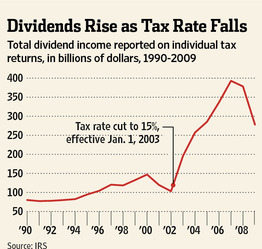
Of course, the real problem with such a budget item is that increasing the tax rate in order to increase tax revenue flat out doesn’t work. IRS data from 1990-2009 clearly shows that when the dividend tax rate was reduced to 15% in 2003, tax revenue skyrocketed. Someone at the White House forgot ignored the data.
Additionally, reports from the UK released today show that the newly implemented tax rate did not generate the kind of revenue it expected (it dropped). As I have written on this topic before, the reaction by Britons upper income earners is not surprising:
Senior sources said that the first official figures indicated that there had been “manoeuvring” by well-off Britons to avoid the new higher rate.
One can only conclude that Obama’s dividend proposal is aimed to further drive a wedge between the “millionaires and billionaires” and the middle class. It makes it look like he’s doing something to those rich corporations. In reality, he knows that his electorate likely won’t realize how this policy would hurt many, many Americans. Let’s hope, for the sake of our economy, that such a devastating proposal will not come to fruition.
One idea might be a “pocketbook protection” plan, which would work as follows: If the average price of gas exceeds $4 a gallon, an additional, automatic payroll tax cut of 1 percent would kick in, as much as $50 per month, per person. The cut would stay in place for at least 90 days; it would disappear when the price fell below $4.00 per gallon.
There are three advantages to this approach. First, because the plan is of limited duration and is capped at $50 a month, its cost is relatively modest — about $5 billion a month, or $20 billion total, assuming the usual four-month gas-price surge. Second, because it isn’t a reduction in gas taxes, it doesn’t weaken any incentives for fuel conservation or efficiency: All workers get $50 to soften the blow of higher gas prices, but the less fuel they use, the more money they save. And third, the relief provides the greatest relative help to lower-income workers who need gas to commute and feel the price pinch the hardest.
Ripple Effect
Admittedly, by decoupling the tax relief from gas-tax collections, the pocketbook protection plan does give some benefit to workers who don’t drive. But any such windfall is modest, and even these non-drivers will need help dealing with the ripple effect of rising gas prices on the costs of other goods and services that are transportation-dependent.
The plan could be almost entirely paid for with a modest, no-loopholes surcharge on corporate taxes on profit derived from the higher gas prices. The administration would be able to avoid pejorative terms such as “windfall” or “excess” profit tax, because the tax is neither confiscatory nor punitive. With higher gas prices, oil companies will make record profit — and a partial surcharge will still leave that profit at record high levels. In other words, the plan isn’t vulnerable to suggestions of creeping, soak-the-rich redistribution. It would leave in place all incentives for oil companies to increase production, do more research and development, and explore alternative fuels. But a modest surcharge would help fund at least a partial pocketbook protection program to make sure the cost of the oil companies’ gain isn’t excessive pain for the rest of us.
So, instead of helping to lower gas prices via domestic oil projects like the Keystone Pipeline (which would also give jobs to Americans), one suggestion is to cut the payroll tax when gas prices are high (underfunding Social Security), and pay for it by a surcharge on corporate taxes. All in the name of “political peril”. Not economic peril — Obama’s political peril.