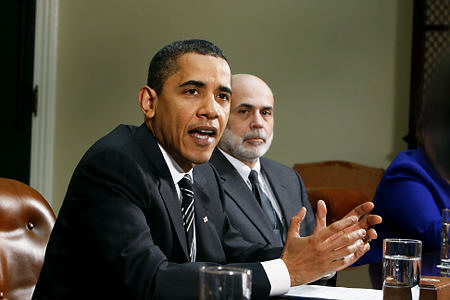
It is really obvious to see that Ben Bernanke was not an independent Fed Chair, but just a lackey for President Obama. Though his responsibility was monetary policy, he was often asked why – despite the most stimulative monetary policy possible – the economy has shown the worst recovery, by far, since the Great Depression more than 80 years ago.
As a student of the Great Depression, Mr. Bernanke was fully aware of the disastrous policies of FDR that impeded the recovery – large tax increases, burdensome regulation, anti-business government programs, and overboard support of union labor- and that President Obama followed suit in every particular.
And yet not a word from Mr. Bernanke that these policies should be questioned. You might be able to say that the President didn’t know any better – you cannot say that about Mr. Bernanke.
I find Mr. Bernanke’s failure to address the exploding Obama regulatory excesses particularly inexcusable. The effect of new regulations from the EPA, NLRB, ObamaCare, Dodd Frank, etc., etc. clearly serves to curtail expansion plans, absorb capital that otherwise would have been used for growth, and increase the costs of starting a new business (clearly scuttling some). At least some meaningful portion of our scrawny recovery can be explained by this regulatory environment.
As Chair of the (supposedly) independent Federal Reserve, Mr. Bernanke owed it to the American people to speak out. This failure should be long-remembered.
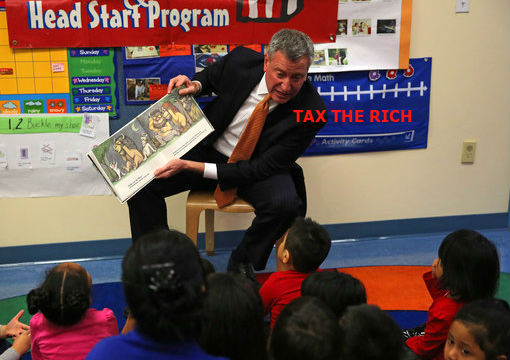
The new pre-school plan presented by Mayor de Blasio reveals just how politically disingenuous he really is.
In his effort to push the progressive agenda he put forth during his campaign, de Blasio has vowed to have universal pre-school in New York State to be paid for only by the wealthiest New Yorkers.
Here’s the logical inconsistancy: If universal pre-school is the all-important and necessary step for all children in their educational development (the merits of which is fodder for another article entirely), then the only logical conclusion is that the cost should also be borne by all taxpayers the way K-12 already is — not just a select few. If “everyone” is not willing to pay his or her fair share of this “necessary” project, then maybe that tells us that it should not be done.
This line of thinking clearly echoes the Obama Administration’s sentiment that the rich “pay just a little bit more”, and it is not welcome in New York.
Today marks the fifth anniversary of the Santinelli Rant on the floor of the Chicago Mercantile Exchange, which spawned the infamous Tea Party (Taxed Enough Already?). Even if you heard it then, it’s definitely worthwhile listening to once more:
The first Tea Party protests subsequently followed on February 27th to protest the American Recovery and Reinvestment Act (ARRA) stimulus bill signed by President Barack Obama on February 17th, 2009.
There is raging debate about whether or not the Tea Party still holds the influence it did during the 2010 Congressional elections as well as whether or not ARRA helped our economy recovery.
“Five years later, the U.S. economy is undoubtedly in a stronger position, thanks to the grit and determination of our nation’s workers and businesses. The economy has now grown for 11 straight quarters, and businesses have added 8.5 million jobs since early 2010. While far more work remains to ensure that the economy provides opportunity for every American, there can be no question that President Obama’s actions to date have laid the groundwork for stronger, more sustainable economic growth in the years ahead.”
At the same time, Obama has more than doubled the public debt. CNS News reported that “the marketable debt of the U.S. government has more than doubled–climbing by 106 percent–while President Barack Obama has been in office, increasing from $5,749,916,000,000 at the end of January 2009 to $11,825,322,000,000 at the end of January 2014”
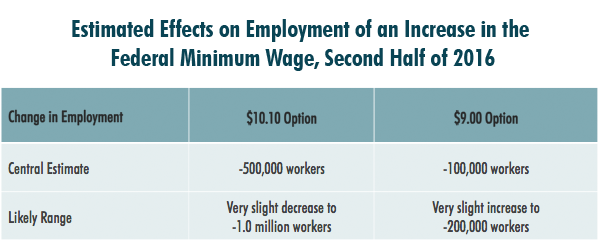
“Increasing the minimum wage would have two principal effects on low-wage workers. Most of them would receive higher pay that would increase their family’s income, and some of those families would see their income rise above the federal poverty threshold. But some jobs for low-wage workers would probably be eliminated, the income of most workers who became jobless would fall substantially, and the share of low-wage workers who were employed would probably fall slightly”
What Options for Increasing the Minimum Wage Did CBO Examine?
For this report, CBO examined the effects on employment and family income of two options for increasing the federal minimum wage:
1) A “$10.10 option”
A “$10.10 option would increase the federal minimum wage from its current rate of $7.25 per hour to $10.10 per hour in three steps—in 2014, 2015, and 2016. After reaching $10.10 in 2016, the minimum wage would be adjusted annually for inflation as measured by the consumer price index.
2) A “$9.00 option”
A “$9.00 option” would raise the federal minimum wage from $7.25 per hour to $9.00 per hour in two steps—in 2015 and 2016. After reaching $9.00 in 2016, the minimum wage would not be subsequently adjusted for inflation.
It was certainly no surprise to most of us the the CBO report showed Obamacare was costing the economy countless jobs. White House and congressional Democrats could have put a rational spin on it – that this was a necessary price to pay in order to get his signature health care proposal implemented, – but they didn’t do that.
Instead, they chose a response which showed them to be the disingenuous hypocrites that they truly are. It also showed that the true intention is simply political — in other words, they wantonly come up with whatever excuse will lose them the least number of votes.
The White House and congressional Democrats have explained the CBO’s job loss outlook to actually be a good thing. The job losses merely reflect the fact that individuals will, going forward, have choices. Such examples include the option to retire before one might have otherwise done so, or perhaps stay at home as a single parent because the government is providing for them (health care) what otherwise only a job could.
But this “logic” is ridiculous. Electing the option to not work when one could do so will certainly prevent many people from getting ahead along the economic chain. And in combination with an extension of food stamp benefits, an extension of unemployment benefits, an extension of other welfare programs, and raising the minimum wage, all are acting in tandem to prevent the upward mobility that the President has said he so sorely wants and unequivocally demands.
He can’t have it both ways. The President cannot be both against economic inequality and simultaneously for policies that maintain prolonged dependence. The preposterous idea that work is now a “lifestyle” choice reveals the shallowness of his commitment to economic success.
This was a great article from Forbes countering the misconception that generic drugs are better for price-cutting in the pharmaceutical world. I encourage you to read the piece in it’s entirety.
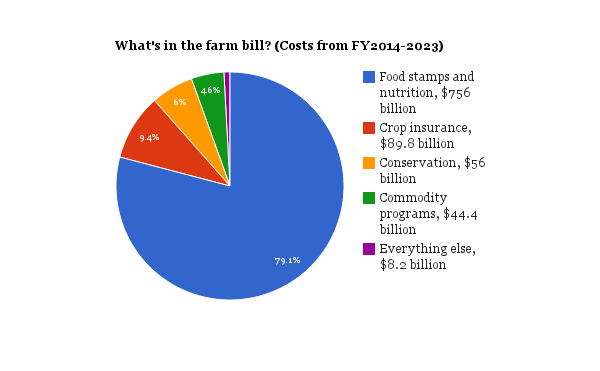
This $956 billion bill will set the course of U.S. food policy for the next half-decade. The old farm bill expired in 2012, and its replacement is 959 pages long, costing some $956.4 billion over 10 years.
The chart below is courtesy of the WaPo.
This bill includes such goodies as:
— $3 million plan for Christmas tree taxes (15 cent levy per tree)
–$100 million will go to study how to get Americans to buy more maple syrup
–$1 million will buy weather radios for rural Americans
–$15 million ‘wool trust fund’
–$170 million program to protect catfish growers from overseas competition
But most of that money goes to food-stamp and nutrition programs, which are administered by the U.S. Department of Agriculture. The 10-year spending total for those entitlements will hit $756 billion under the new law.