by | ARTICLES, BUSINESS, ECONOMY, GOVERNMENT, HYPOCRISY, OBAMA, POLITICS
Bernie Sanders recently chose to test the waters of a possible Presidential campaign by weighing in on the deliberations regarding the Post Office. Thankfully, we have this Op-Ed so early on, because it reveals Sanders’ complete and utter inability to comprehend basic economics and accounting.
Bernie argues two main points: 1) the Post Office is not broke and 2) those who believe it is are “anti-government”, “wealthy special interest”, profit-seeking, or all of the above. These points rest entirely on his premise that pre-funding health benefits to postal workers is a very bad thing.
Sanders actually believes that planning for future promised benefits is not a fiscally sound practice. If he feels this way about the Post Office, surely he feels the same about Social Security and Medicare (two programs who have trillions in future liabilities). Does Sanders know that his type of accounting would land any business executive in jail?
Sanders says that if we didn’t have to pre-fund future benefits, than the Post Office would make a profit. Simple, right?
What he fails to mention that if we didn’t pre-fund benefits, the Post Office would merely be sloughing off paying its promises to some future nebulous day and time for some other taxpayers else to take care of –only when its liabilities were astronomical and the finances were on the edge of a precipice.
That result is precisely what we are facing programs like Social Security, Medicare, and many defined benefits plans across the country: politicians made future monetary promises without planning for them, and now the economic pressure has ballooned into severe fiscal instability. Sanders belongs to the ‘spend first, fix (maybe) later” group of bureaucrats who refuse to follow basic accounting practices like any business would be required to practice.
With the Post Office, we actually have an quasi-government entity following good, non-gimmick accounting so taxpayers can see first-hand the true financial picture (current and future) of the post-office. Pre-funding benefits to account for future and current liabilities is a proper and healthy way to do business. And if the Post Office cannot turn a profit while protecting its current and future liabilities, than it must make changes to its business operations
By repealing the legislation to pay for future liabilities, Bernie Sanders is ostensibly demanding someone in the future — your kids and grandkids — to clean up the mess of his government and his generation’s deliberately poor financial planning.
Which bring us two his second point. Bernie Sanders does what the Left does best, which is resort to name calling, straw-man arguments to build up his weak ideas. Sanders actually thinks that those who wish to pass on a health economic future while practice basic and principled accounting practices are anti-government, bought-and-paid-for, or profit-mongers. No, Mr. Sanders, we only wish for the government and its entities to practice the same kind of accounting standards that any other business or family is required to do.
Watch out, America — Bernie Sanders is just more of the same. Another bureaucratic imbecile who refuses to face economic and financial realities when it comes to the Post Office — or any big government program which deals with current and future liabilities. Sanders would rather pass the buck to the next generation in order to save a few union jobs.
by | ARTICLES, BLOG, FREEDOM, GOVERNMENT, NEW YORK, OBAMACARE
Would any consumer-driven industry be able to get away with this?
“Surprise medical bills occur when a consumer does everything possible to use hospitals and doctors that are in the consumer’s insurance plan, but nonetheless receives a bill from a specialist or other medical provider by whom the consumer did not know he or she would be treated, and who was outside his or her plan’s network of providers.
Worse, a relatively small but significant number of out-of-network specialists appear to take advantage in emergency care situations in particular, where the consumer has little choice or ability to “shop” for an appropriate provider. Too frequently, out-of-network specialists charge excessive fees — many times larger than what private or public insurers typically allow. In one example, a New Yorker who severed his finger in an accident went to participating hospital and ultimately received an $83,000 bill from a plastic surgeon who reattached the finger but – unbeknownst to the patient — was outside the insured’s network of providers.
The problem of surprise bills is not limited to emergency situations. They also can occur when a consumer schedules health care services in advance and an in-network provider, such as an anesthesiologist, is not available. In these instances, consumers are not told that the provider is out-of-network, not informed about how much the provider will charge, or not advised how much the insurer will cover. This lack of disclosure not only ill serves the consumer, but also undermines the efficiency of the health insurance market because consumers cannot effectively comparison shop for benefits or services”
This except from is part of a larger letter from Benjamin M. Lawsky, Superintendent of Financial Services for New York State, written to members of the New York State Legislature. You can read the letter here.
In any other industry, this would ALL be considered fraud.
by | ARTICLES, ECONOMY, GOVERNMENT
Janet Yellen, the new Fed Chairman, recently spoke about her decision to continue low interest rates, calling the policy “beneficial.” As the WSJ noted, Yellen described how she seeks to assure the markets:
“By keeping interest rates low, we are trying to make homes more affordable and revive the housing market,” she said. “We are trying to make it cheaper for businesses to build, expand and hire. We are trying to lower the costs of buying a car that can carry a worker to a new job and kids to school, and our policies are also spurring the revival of the auto industry.”
The problem with Yellen’s approach to the economy is that she completely misunderstands how interest rates affect the economy, an incredulous thing considering that she is the Fed Chairman.
When Yellen describes the benefits of low interest rates, she gives several reasons for them: homeownership, business growth, and car prices. However, the real estate market and auto industries are actually doing fine, and businesses are not using low interest rates to borrow to hire.
The crux of the problem is that all of Yellen’s examples analyze the economy from a consumption perspective. While consumption does affect the economy, it is not nearly a powerful a stimulant as investment. Any basic economics course will tell you that.
The real reason for the continued sluggishness is that investors are prevented from earning any real and considerable income when interest rates remain low. When investors don’t see a decent return on investment (ROI), they stop investing.
What else? Couple the investment problem with the administration’s policies that hurt growth such as burdensome regulations, minimum wage increases, food stamp usage, and Unemployment Insurance extensions, and you have a recovery that is best described as tepid.
Yellen should know better than to appeal to emotion rather than basic economics when making her Fed decisions. The choice to continue low interest rates for at least another year guarantees an anaemic economy for the foreseeable future.
by | ARTICLES, FREEDOM, GOVERNMENT, OBAMA, QUICKLY NOTED
From Katie Pavlich at Townhall.com
“According to new IRS emails obtained through a Freedom of Information Act request from Judicial Watch, former head of tax exempt groups at the IRS Lois Lerner was in contact with the Department of Justice in May 2013 about whether tax exempt groups could be criminally prosecuted for “lying” about political activity.
JW IRS doc
Read the full story here
by | BLOG
From PJMedia
“Emails released today by the House Government Oversight and Reform Committee show that Rep. Elijah Cummings (D-MD) has some explaining to do. The emails show that Cummings and the IRS were asking for nearly identical information from election integrity watchdog True the Vote. Further, the emails show communication as Lerner was feeding information to Cummings and his staff.
The communication occurred in 2012, before the public was ever aware of the ongoing and widespread IRS abuse of Tea Party and conservative groups. In a press release detailing the newly delivered emails, committee Chairman Darrell Issa asks Cummings to answer for himself”
You can read the full exchange here
by | ARTICLES, ECONOMY, OBAMA, OBAMACARE, TAXES
Americans for Tax Reform (ATR) has done an analysis of taxes that Obama has proposed since taking office, by looking the Obama administration budgets for FY2010 – FY2015.
“The 442 total proposed tax increases does not include the 20 tax increases Obama signed into law as part of Obamacare.
Here’s a breakdown of potential taxes by by budget year:
“-79 tax increases for FY 2010
-52 tax increases for FY 2011
-47 tax increases for FY 2012
-34 tax increases for FY 2013
-137 tax increases for FY 2014
-93 tax increases for FY 2015
“History tells us what Obama was able to do. This list reminds us of what Obama wanted to do,”
by | ARTICLES
With a few days left before taxes are due, President Obama released some information regarding his 2013 taxes. Obama makes $400,000 in income as President, and he reported a total an adjusted gross income of $481,098.
Income from book sales appears to be in steep decline from previous years. “Obama received $31,139 from Random House and $85,041 from Dystel & Goderich Literary Management, for a total of $116,180 in book sales. That combined total compares with $273,739 in similar payments he received in 2012. There was a big drop in the amount from Random House, which paid Obama $162,789 in 2012”.
There was something else in noticeable decline from 2012: donations to charity. In 2012, the Obama’s donated $150,034. This year, the “Obamas reported donating $59,251 to 32 charities, which helped lower their overall tax bill…Their largest charitable gift last year, $8,751, went to the Fisher House Foundation, which supports military families. The Obamas gave the foundation $103,871 in 2012”.
In comparison, Obama paid less taxes than Vice President Joe Biden. The Biden’s had a “reported adjusted gross income of $407,009. The Bidens paid $96,378 in total federal tax for 2013, amounting to an effective tax rate of 23.7 percent…The Bidens contributed $20,523 to charity in 2013, including contributing the royalties received from Dr. Biden’s children’s book, net of taxes, to the USO.”
by | ARTICLES, ECONOMY, FREEDOM, TAXES
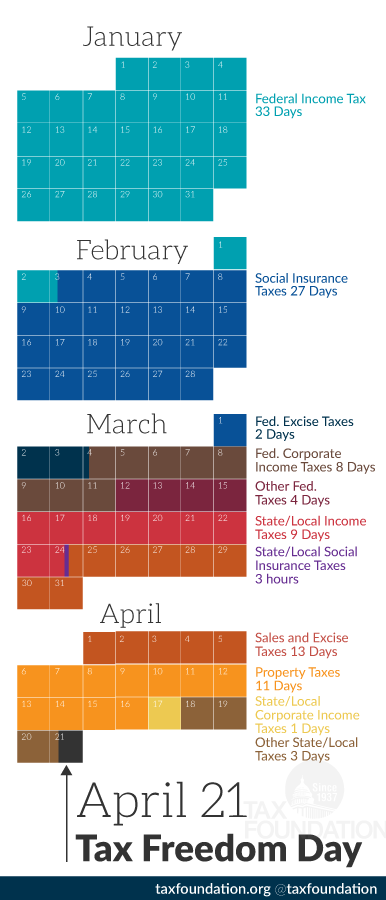
The Tax Foundation releases an annual “Tax Freedom Day” report, which calculates “the day when the nation as a whole has earned enough money to pay its total tax bill for year”.
This is done by looking at federal budget projections, data from the U.S. Census and the Bureau of Economic Analysis, and projections of state & local taxes. Then, all the federal, state, and local taxes are divided by the country’s income.
This year, Tax Freedom day is April 21st, 3 days later than last year. The Tax Foundation cites sluggish economic growth and recovery.
Here’s a neat graphic from the Tax Foundation, which shows the breakdown:
The Tax Foundation calculates that “in 2014, Americans will pay $3.0 trillion in federal taxes and $1.5 trillion in state taxes, for a total tax bill of $4.5 trillion, or 30.2 percent of income”.
You can also visit the site to see how your state factors in, or what the Tax Freedom date is if you include federal borrowing.