by | BLOG, OBAMA, POLITICS, TRUMP
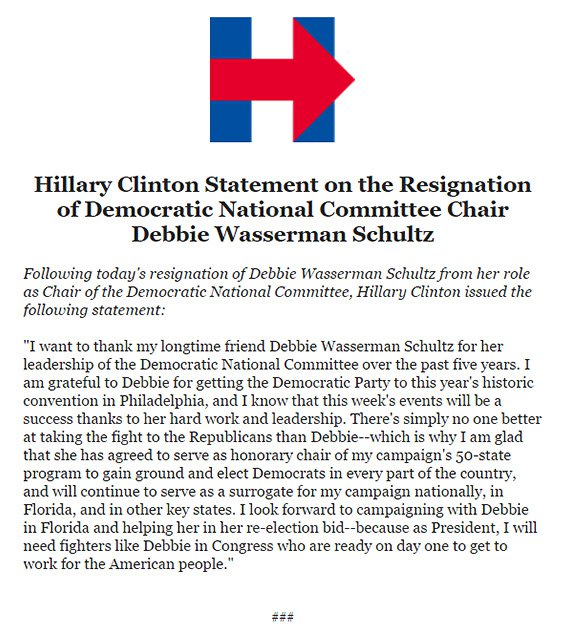
After the embarrassing Democratic National Committee (DNC) Wikileaks dump, Debbie Wasserman Schultz resigned earlier today from her position as Chair of the Democratic National Committee. Wasting no time, Hillary Clinton immediately brought Debbie onto her campaign in several key capacities. You can read the text of the press release below. It’s also available on Hillary Clinton’s campaign website.
by | ARTICLES, ECONOMY, OBAMA, OBAMACARE, TAXES
I just read a recent Letter to the Editor in the Wall Street Journal from a Francis X. Cavanaugh, “founding chief executive of the Federal Retirement Thrift Investment Board.” I guess his title allows him the ability to be an ignorant elitist, mocking the alarm of the ordinary American with the current amount of crushing US debt.
Mr. Cavanaugh writes that the “concern that ‘we have borrowed so heavily from future generations’ is baseless.” Baseless. Really Mr. Cavanaugh? As if anyone concerned with debt is a poor, uneducated, silly, misunderstood citizen, and all the smart federal people know and understand that the debt will never be paid off, never needs to be paid off, and therefore is a non-issue. How utterly wrong.
In his economic ignorance, Mr. Cavanaugh must be assuming that, as with major corporations and other organizations with indefinite lives, debt can be a part of a permanent capital structure, so there is no need to actually pay it off. But in order for the debt to be rational, it needed to be incurred to acquire something with ongoing benefit – such as land or equipment whose ongoing use will justify the ongoing debt service to pay for it.
That is the difference between the federal government and other entities that will maintain “permanent “ debt. Corporate permanent debt has funded capital improvements that will provide benefits into the future. They would never use debt to fund current operations, because this would burden future activities with having to pay back unproductive debt. In contrast, federal debt is funding only operating deficits – paying for more vote-buying crony-building current goodies than our tax receipts could provide – and which will need to be paid back by our children and grandchildren who will have received none of the goodies.And the cumulative effect of piling operating deficits on top of operating deficits is catastrophic.
Mr. Cavanaugh does not believe that the debt needs to be paid? What needs to be paid — at minimum — is the interest and the capacity to roll over the debt coming due; however, when the amount of debt explodes such as it has in the past 8 years, the interest explodes too, especially when interest incurred at historically low rates will need to be refinanced at rates much higher. Likewise, those creditors funding the debt will certainly take pause or stop funding all together. Subsequently, the interest liabilities become a debt for future generations paying for the debt service and the unfunded liabilities of the past generations’ profligate spending.
The attitude of Mr. Francis X. Cavanaugh is thoroughly repulsive — but what do you expect from a bureaucrat whose sole job was to oversee, protect, and administer the retirement savings and investment plans for Federal employees?
by | ARTICLES, BLOG, ECONOMY, FREEDOM, GOVERNMENT, HYPOCRISY, OBAMA, POLITICS, TAXES
Dear Speaker Ryan,
I write to you today to ask about why the Jones Act amendment proposed by Rep. Gary Palmer and the reasonable minimum wage exceptions were left out of the Puerto Rican assistance act (PROMESA). If the purpose of the fiscal rescue bill was to aid the Puerto Ricans suffering from a fledgling economy and corrupt government, these two items would have greatly helped the Puerto Rican people.
The Jones Act, as you know, requires that all cargo shipped between U.S. ports be carried by U.S.-built, U.S.-crewed, U.S.-owned ships. The J0nes Act puts an unnecessary burden on our U.S territories; exempting Puerto Rico from this provision would have provided a much-needed burst of commerce and lower the cost of living. As it is now, the Jones Act limits international competition for competition for imports and creates higher taxes on basic necessities such as energy and food. This recent article in the National Interest, which covers the history and impact of the Jones Act, is a must-read.
In a similar way, allowing Puerto Rico to be exempted from federal minimum wage requirements would give businesses a chance to compete without artificial wage impediments. How can it be acceptable to deny the Puerto Rican people this tool to help aid recovery, when it once allowed American Samoa to be exempted as a favor to Nancy Pelosi because of her constituent operations there? When the favor was discovered and the exemption rescinded, the damage to the American Samoa people had already been done; the amount of subsequent layoffs and hiring freezes prompted delays in phasing in the minimum wage requirements in 2010, 2012, and most recently in 2015. Why in the world would not then make a minimum wage exemption for the Puerto Rico in order to help spur more rapid job creation and economic growth?
This would be the right time for Congress to enact stand alone law exemption US territories for laws such as the Jones Act and federal minimum wage. In that way, our territories can not only manage to survive, but actually thrive.
by | ARTICLES, ECONOMY, FREEDOM, GOVERNMENT, POLITICS, TAXES
Don Boudreaux over at Cafe Hayek does a nice piece a few weeks ago, outlining the inefficiency of rent control. As his comments on the subject were part of a larger discussion, I have summarized his points below. If you want to go back to the original, you can go here.
Brian,
Boudreaux notes that “the assumption of a perfectly inelastic supply of rental housing is not realistic.” But at the same time, he wagers it is incorrect to say that, were this assumption to hold in reality, rent control would create no deadweight loss.
In what Deirdre McCloskey calls “the first act” there is indeed, unlike with an upward-sloping supply curve of rental housing, no deadweight loss. It’s all transfer from landlords to tenants. But unless we assume also a perfectly inelastic demand for rental housing, rent control will in the second act cause current and prospective renters to waste resources as each competes to increase his or her chances of securing one of the rent-controlled apartments. Losses – ones in every relevant way comparable to conventional deadweight losses – ensue.
Picture a standard supply-and-demand graph, but one in which the supply curve is perfectly vertical. With the demand curve shaped as it usually is – namely, sloping downward to the right – rent control will still cause a shortage of rental housing. Tenants will therefore compete more vigorously – now using only non-price means of competition – to secure these rental units. The use of resources in such non-price competition – for example, wining and dining landlords, racing or keeping constant vigilance to sign up for newly vacated rental units, whatever – is a waste of resources from society’s perspective.
It’s true that these wastes are conventionally called “rent-seeking wastes” rather than “deadweight losses.” But Boudreaux takes Gordon Tullock’s point to be that rent-seeking-‘rectangle’ losses are no less real or important losses than are deadweight-loss (or Harberger) ‘triangle’ losses: both losses act as deadweights on society. Valuable goods and services that would otherwise have been produced remain unproduced because of the interventions that cause these losses. Both losses emerge because government interventions render uses of resources that were once profitable now unprofitable. Both losses ‘measure’ the reduction in valuable output. Both losses ‘measure’ the reduction in the size of the economic pie.
Boudreaux doesn’t wish to defend too strongly his claim that rent-seeking losses should be called and classified as “deadweight losses” (although I do believe that that claim is defensible). But he does wish to insist that the absence of conventionally defined deadweight losses does not mean that an intervention, such as rent control, effects only a transfer and, therefore, causes no real losses. The resulting non-price competition among potential renters results in losses.
Note too that he mentions neither rent-seeking efforts by tenants to secure rent-control regulation from government nor rent-‘protecting’* efforts by landlords to fight rent control. These rent-seeking and rent-‘protecting’ efforts only increase the social losses from rent control beyond the losses that Boudreaux identifies above.
by | ARTICLES, BLOG, ECONOMY, ELECTIONS, FREEDOM, OBAMA, POLITICS, TAXES
Here’s another ridiculous article by “economist” Grep Ip, wondering aloud once again why the economy isn’t doing any better. (“Why Aren’t Low Rates Working? Blame Dividends!” WSJ, June 5). Either he’s truly incompetent as an economist not to see the detrimental effects of government policies on businesses and the economy, or he’s playing dumb to give political cover to the Obama Administration by pretending their policies aren’t harmful and looking the other way in his analysis.
Ip writes, “One of the great mysteries of the recovery is why low interest rates have done so little to lift business investment. After all, that is supposed to be one of the ways monetary policy works: A lower cost of capital makes any project more viable. But what if lower interest rates are actually hurting investment by encouraging companies to pay dividends or buyback stock instead?”
This is exactly what is happening — it’s no mystery. But he draws no substantial conclusions. If he would just come down from his ivory tower of what is “supposed to happen” under Keynesian economics, and actually observe what is happening, he might actually learn something. The fact of the matter is, Obama’s policies are destroying our business environment and eliminating the opportunity.
The burden of overregulation, the increases in taxes, the litigation-friendly environment, the overreaching government agencies, Obamacare, unprecedented debt and more — all of these factors cause businesses to essentially pause their business strategy. Who in their right mind really would consider substantial investment in an environment that is hostile to workers, and an economy that is now seeing more businesses close instead of open? The risk is often too great. Sitting it out is a safer bet.
Not only is it not a mystery as to why low interest rates haven’t spurred growth, it’s a no-brainer. To ignore the government’s effect on business and the economy is unprofessional and incompetent. “It’s the government, stupid!”
by | BLOG
by | ARTICLES, BLOG, BUSINESS, FREEDOM, HYPOCRISY, OBAMA, POLITICS
To the President of Brown University,
I read with interest your recent commitment to increasing diversity at Brown University spending $100 million over the next 5-7 years in order to hire 60 more faculty members is an immense undertaking.
You wrote, “Many of the efforts detailed in our plan are focused on faculty diversity through targeted strategies such as early identification programs, postdoctoral programs and cluster hiring. By hiring the best and the brightest from a full range of backgrounds, we’ll put Brown in a position to attract exceptional students and scholars into our applicant pools.”
This is truly fantastic. Thus, I would like to know just how many conservative and libertarian professors Brown has hired or plans to hire as part of this initiative?
You also enthusiastically and “explicitly rejected mandatory ‘diversity training’, and cite diversity as “a key element of our core mission of education and discovery” being “integral to our commitment to cultivating an intellectual environment in which a wide range of views are represented and all individuals are treated with respect.” Agreed! Without libertarian and conservative point of views, you unequivocally cannot have a full, diverse point of view for learning. You certainly cannot possibly have a wide range of views if you have twice as many Marxist-leaning professors as the rest!
Supporting the necessity for diversity in higher education as a means for open conversation, a free exchange of ideas, and mutual respect. Without belittling the need to increase representation from historically underrepresented groups, it would be rather flawed to only focus on genetic diversity, while completely ignoring the expansion of diversity in political and ideological thought.
I look forward to hearing about your diversity expansion will include those that are politically and intellectually underrepresented at such a prestigious institution of higher learning.
by | ARTICLES, CONSTITUTION, ECONOMY, FREEDOM, GOVERNMENT, OBAMA, POLITICS, TAXES
The Competitive Enterprise Institute periodically reviews the Federal Register and the amount of regulations that the Obama Administration churns out. Here’s a snapshot of it; it’s the daily publication of proposed and final administrative regulations of federal agencies.
“The Federal Register once again topped 2,000 pages last week, and included a year-high 137 final regulations, ranging from eggs to groupers.
On to the data:
The amount of regulations have exploded in recent years and is a major reason why the economy hasn’t recovered.