A quick little snippet coming from the AP — a new poll shows that more Americans would rather cut spending than raise taxes
56 percent to 31 percent, more embraced cuts in government services than higher taxes as the best medicine for the budget, according to the survey, which was conducted Feb. 16 to 20.
Thankfully, a majority of Americans have more sense than our Administration these days
The Wall Street Journal reported today that in Obama’s budget, the corporate tax rate on dividend taxes would triple. What kind of tax rates are we looking at? 44.8% (currently 15%).
President Obama’s 2013 budget is the gift that keeps on giving—to government. One buried surprise is his proposal to triple the tax rate on corporate dividends, which believe it or not is higher than in his previous budgets.
Mr. Obama is proposing to raise the dividend tax rate to the higher personal income tax rate of 39.6% that will kick in next year. Add in the planned phase-out of deductions and exemptions, and the rate hits 41%. Then add the 3.8% investment tax surcharge in ObamaCare, and the new dividend tax rate in 2013 would be 44.8%—nearly three times today’s 15% rate.
Keep in mind that dividends are paid to shareholders only after the corporation pays taxes on its profits. So assuming a maximum 35% corporate tax rate and a 44.8% dividend tax, the total tax on corporate earnings passed through as dividends would be 64.1%.
To whom does this high tax rate apply? Millionaires and billionaires, of course. Remember them — the ones classified by the IRS who earn $200K/year? AKA “the wealthy”.
The WSJ goes on to show how both retirees (who received most of their income from divideds) and stock holders (the burden of extra taxes will be shared by all shareholders, regardless of income).
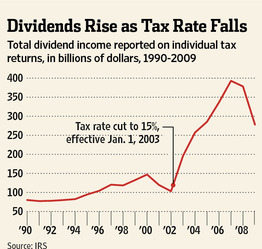
Of course, the real problem with such a budget item is that increasing the tax rate in order to increase tax revenue flat out doesn’t work. IRS data from 1990-2009 clearly shows that when the dividend tax rate was reduced to 15% in 2003, tax revenue skyrocketed. Someone at the White House forgot ignored the data.
Additionally, reports from the UK released today show that the newly implemented tax rate did not generate the kind of revenue it expected (it dropped). As I have written on this topic before, the reaction by Britons upper income earners is not surprising:
Senior sources said that the first official figures indicated that there had been “manoeuvring” by well-off Britons to avoid the new higher rate.
One can only conclude that Obama’s dividend proposal is aimed to further drive a wedge between the “millionaires and billionaires” and the middle class. It makes it look like he’s doing something to those rich corporations. In reality, he knows that his electorate likely won’t realize how this policy would hurt many, many Americans. Let’s hope, for the sake of our economy, that such a devastating proposal will not come to fruition.
One idea might be a “pocketbook protection” plan, which would work as follows: If the average price of gas exceeds $4 a gallon, an additional, automatic payroll tax cut of 1 percent would kick in, as much as $50 per month, per person. The cut would stay in place for at least 90 days; it would disappear when the price fell below $4.00 per gallon.
There are three advantages to this approach. First, because the plan is of limited duration and is capped at $50 a month, its cost is relatively modest — about $5 billion a month, or $20 billion total, assuming the usual four-month gas-price surge. Second, because it isn’t a reduction in gas taxes, it doesn’t weaken any incentives for fuel conservation or efficiency: All workers get $50 to soften the blow of higher gas prices, but the less fuel they use, the more money they save. And third, the relief provides the greatest relative help to lower-income workers who need gas to commute and feel the price pinch the hardest.
Ripple Effect
Admittedly, by decoupling the tax relief from gas-tax collections, the pocketbook protection plan does give some benefit to workers who don’t drive. But any such windfall is modest, and even these non-drivers will need help dealing with the ripple effect of rising gas prices on the costs of other goods and services that are transportation-dependent.
The plan could be almost entirely paid for with a modest, no-loopholes surcharge on corporate taxes on profit derived from the higher gas prices. The administration would be able to avoid pejorative terms such as “windfall” or “excess” profit tax, because the tax is neither confiscatory nor punitive. With higher gas prices, oil companies will make record profit — and a partial surcharge will still leave that profit at record high levels. In other words, the plan isn’t vulnerable to suggestions of creeping, soak-the-rich redistribution. It would leave in place all incentives for oil companies to increase production, do more research and development, and explore alternative fuels. But a modest surcharge would help fund at least a partial pocketbook protection program to make sure the cost of the oil companies’ gain isn’t excessive pain for the rest of us.
So, instead of helping to lower gas prices via domestic oil projects like the Keystone Pipeline (which would also give jobs to Americans), one suggestion is to cut the payroll tax when gas prices are high (underfunding Social Security), and pay for it by a surcharge on corporate taxes. All in the name of “political peril”. Not economic peril — Obama’s political peril.
There are plenty of reasons for the high prices, and lots of reasons to expect a big price surge in the spring, said Tom Kloza, chief oil analyst for Oil Price Information Service.
“Early February crude oil prices are higher than they’ve ever been on similar calendar dates through the years, and the price of crude sets the standard for gasoline prices,” Kloza said.
In addition, several refineries have been mothballed in recent months, he said, and some of those refineries “represented the key to a smooth spring transition from winter-to-spring gasoline.” The annual change in gasoline formulas is mandated by pollution-fighting regulations.
However, one overlooked fact regarding the Keystone XL Pipeline is that its rejection by President Obama has directly affected rise of gas prices in recent weeks. Although the pipeline (and ANWR, and other major oil projects) have multi-year lead times, the very fact of a project of this magnitude moving ahead has an immediate effect on the markets by changing the traders’ expectations of future supply. Having more oil available in the marketplace contributes to lower prices for consumers. So when the project was tabled, the markets reacted accordingly.
This administration has once again shown to its hostility toward domestic oil while pandering to the environmentalist electorate. The rejection of such an important project — with the capacity to offer significant work for Americans — only hurts our economy further.
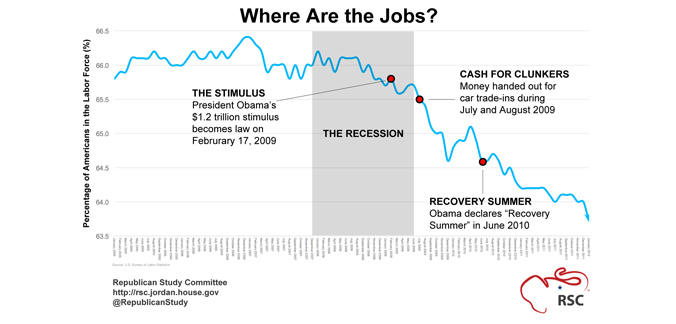
The American Recovery and Reinvestment Act (ARRA) stimulus bill was signed exactly by President Barack Obama on February 17th, 2009. We were told how this would help Americans go back to work while creating more jobs. Yep.
Well, isn’t this cozy. The Occupy movement, which began in September, has occupied several universities this spring. USA Today highlights a course being taught at Roosevelt University in Chicago (surprise?) called “Occupy Everywhere”. Similar classes on the history and/or significance of the Occupy cause are being offered at Brown University, USC-San Diego, and New York University. While Columbia could not get approval for such a class in time, it did offer college credit for participation in OWS.
This seems like the perfect opportunity to infiltrate academia just in time for the 2012 election. Don’t forget, the college vote overwhelmingly supported Obama in 2008. There’s even an occupycolleges.org website.
I wonder how many classes are being offered regarding a movement that will celebrate its 3rd birthday in a few days? Sparked by the Rick Santelli “rant” on the floor of the Chicago Mercantile Exchange on February 19, the first Tea Party protests were organized on February 27, 2009. In contrast to the months-long Occupy movement — well noted for filth and crime — the Tea Party significantly impacted the 2010 Congressional elections merely a year later, and has continued to grow as an organized, grassroots group.
The desperation on the Left here is astounding, since most Americans have moved on from the Occupy Movement. At the ivory towers, however, I suppose the closest we could get to a Tea Party class is a course on the Constitution. If they offer one.
The recent controversy over Obama’s attempted coercion and erosion of religious liberty reminded me of an essay Thomas Sowell wrote shortly after the oil spill. Sowell made the case that the U.S. is on the slippery slope to tyranny, cited the action by the Obama administration regarding compensation for the oil spill victims as an example. He wondered, “[j]ust where in the Constitution of the United States does it say that a president has the authority to extract vast sums of money from a private enterprise and distribute it as he sees fit to whomever he deems worthy of compensation? Nowhere.” And Sowell is correct. Just as Obama acted in such a manner then, his latest antics show that the slope is getting more slippery.
The audacity of our president to mandate that citizens violate their religious conscience by paying for and subsidizing things they are against is striking. Just as egregious is his shell game “compromise” – where he mandates that a private enterprise directly shoulder the cost themselves of those things (which a large percentage of the population opposes). Not that his proposal changes much anything in the way of liberty; the issue here is, once again, that we have actions by our President which are very clearly unconstitutional.
Our Constitution tells us that the the federal government has the power to provide for the common Defense and general Welfare of the United States (Article 1, Section 8). The rest of the powers enumerated in this part mainly relate to the military and defense, as well as some specific items, such as roads and post offices. That’s it. But this administration has exploited the feel-good term of “general welfare” as a green light to spend drastically — and unconstitutionally.
So how did this happen? And why is it unconstitutional?
Let’s back to the beginning of tax and spend mentality, specifically the 16th amendment – the full implementation of the federal income tax. Before this passed in 1913, Congress was limited by its income due to the type of taxes the Constitution allowed. The Supreme Court had actually ruled that the income tax was unconstitutional. But this new federal income tax was a different type of tax levy than previous tax measures because it included corporations (so technically that was an excise tax), and it was not a proportional tax. It was based on income, which is disproportional: some are rich, others poor. With the new income tax, those who were working and accumulating large sums of wealth became a revenue stream for our Congress.
Government was grossly expanded during the Great Depression and New Deal when FDR gave America programs of public works such as the National Recovery Administration, and monetary supports like Social Security. The litany of abuse of federal power has been well documented and the salient point is that role of government and our relationship to the Constitution was forever changed.
The explosion of economic meddling and bloated government since then has been extraordinary. But we’ve been told it’s okay because it’s all in the name of General Welfare. We’ve slowly become more and more accustomed to the idea that the government can—and should—take care of its citizens in all facets of our lives. But that is not the original intent of government, according to our Founding Fathers.
Indeed, they were keenly aware of the potential for abuse of the welfare clause. Jefferson himself emphatically declared in 1798 that “Congress has not unlimited powers to provide for the general welfare, but only those specifically enumerated.”
What’s different about this current administration, is that Obama has explicitly stated, even before he became President, that he favors wealth redistribution. This is evident in his actions such as the aforementioned oil compensation. He is working vigorously to expand the welfare state.
Under the guise of “rights”, Obama has pushed forth the notion that we are entitled to many things. But these programs are not free, nor are they charitable. It simply transfers wealth from those who can afford it most to those who can afford it less. This idea in itself is not new in our country. But the Obama administration is continuously trying to spread the wealth around in more deep-reaching personal and private sectors. The so-called “Buffet Rule” , for instance, adds a surcharge to millionaires, just because he can. (He needs the revenue for his programs). And the latest: free birth control for all!
His administration appointees, aptly called “czars”, are mainly reflections of his own economic ideas. Most are against free market principles and favor great spending. But alarmingly, they are neither confirmed by Congress nor answerable to Obama, a clear violation of our Constitution. And the IRS has become the chief money launderer, as seen from the growing list of tax credits since the first stimulus package, his jobs bill and his recent SOTU address. But all these tax credits merely do is subsidize various industries while push an underlying agenda —but “credits” sound good to the pundits and citizens. That’s why we will never see true tax code reform.
We’ve seen bailouts of industries deemed “too big to fail” by taking our taxpayer money and nationalizing businesses. Putting government-decided caps on wages and imposing 90% taxes on employee compensation packages. And of course, Obamacare is among the biggest farces of all. Deeming healthcare a crisis is another example of false advertising in order to create a reason for the intrusion into our lives and money, and now, our religious liberty. As William Pitt the Younger sagely put it, “Necessity is the plea for every infringement of human freedom. It is the argument of tyrants; it is the creed of slaves.”
Ironically, those who claim to love liberty the most are those who have done the most damage. Calling the Constitution a “living document” is code word for manipulation and interpretation, justifying the general welfare clause time and again in order to spend recklessly, regulate more, oftentimes via unconstitutional procedures.
President Obama swore an oath “to preserve, protect, and defend the Constitution” as he assumed the presidency. Yet he is busily ignoring it, rerouting it, and creating a new language of “rights” that are not contained therein but provide persuasive lingo to pass his calculated policies.
The difference between FDR and Obama is the era in which we live. We have allowed the slope to get slippery since the New Deal so much that our own politicians on both sides of the aisle have become accustomed to government intrusion and spending – so much that they have abrogated their fiduciary responsibility to the taxpayer to act as stewards of taxpayer money. And they have forgotten to ask the most important question of all, for us all: Is This Constitutional?
During the State of the Union, we heard President Obama talk repeatedly about fairness and taxes as he painted a picture of income inequality. The problem is that income inequality really is a myth, yet it is being perpetuated: the gap between rich and poor has never been higher.
The data used most frequently to substantiate this claim is a Congressional Budget Office (CBO) report from October 2011. However, the glaring problem with this report is that it only covers the period from 1979 to 2007 — ending right before the Great Recession. Convenient?
So in November, Ron Schmidt of the University of Rochester School of Business Administration, did an analysis of the CBO data and compared it to IRS data during the same time period — but through the year 2009, the latest year for which IRS data was available. He found something very, very different. In a reported summary,
According to IRS data, which extend through 2009, the average nominal Adjusted Gross Income (AGI) for filers with AGI of at least $500,000 declined by 17.8 percent from 2007 to 2009, and their average after-tax income declined by 19.9 percent. For those with AGI of less than $500,000, AGI declined by only 2.6 percent, and after-tax income declined by only 1.5 percent. These numbers certainly do not indicate an increase in income inequality.
In fact, there has been a marked decline in income inequality over the last decade. From 2000 to 2009, average AGI declined by 15.0 percent and average after-tax income declined by 11.0 percent for returns with AGI of at least $500,000. (Filers with an AGI of at least $500,000 represent 0.5 percent of all returns in both years, so this comparison is similar in spirit to the CBO report, which looks at the top 1 percent of households.) For all other returns, there were increases of 14.6 percent for average AGI and 17.3 percent for average after-tax income.
It revealed that income inequality is not only not at an all-time high, but also, due to the nature of economic and business cycles, it is relatively the same as it was twenty-five years ago.
The repeated calls for fairness last night reminds one of Margaret Thatcher’s famous speech in front of the House of Commons where she lambasted her opposition for suggesting that the gap between rich and poor had widened. The Prime Minister People responded that “people on all levels of income are better off than they were in 1979. The honorable gentleman is saying that he would rather that the poor were poorer, provided that the rich were less rich. That way one will never create the wealth for better social services, as we have. What a policy. Yes, he would rather have the poor poorer, provided that the rich were less rich. That is the Liberal policy”.
Liberal policy indeed is alive and well in America today. Thankfully, income inequality is not.
Though Obama may be pretending to draw a line in the sand between himself and the Republicans, he is really drawing a line for voters: Them vs The Rich Guy (millionaires and billionaires, anyone?) Setting up the narrative in the State of the Union allows Obama to pander to the electorate during this campaign season and relentlessly go after those who have proven to be successful as a source of increased tax revenue to cover his spending problem.