Class warfare is a key component of Obama’s policies and re-election rhetoric. The components of such a tactic are easily recognized: 1) the political opponent will hurt those among us who are most vulnerable (elderly, poor, etc); 2) the political opponent does not care about the “middle class”; 3) the political opponent wants to benefit those most advantaged (the rich/elite). The third point of this strategy is the one that is most popular with Obama, as he continuously and intentionally rails against “millionaires and billionaires” in order to separate that particular population from mainstream America.
Besides the obvious baseness of such an argument coming from the President of the United States, it is critically important to note that he doesn’t actually ever define a millionaire or billionaire. The amount of true millionaires and billionaires are so few in number, that taxing them more – as Obama plans to do – will not help with any significant deficit reduction. His assertion is pure dishonest political speech because you cannot possibly create enough revenue from the millionaire/billionaire population even if you were to tax them at 100%. Our fiscal situation is so dire in this country that an increased tax on this group in any large or small amount solves nothing.
Unfortunately, none of this matters to Obama. He intentionally throws the labels around so that they conveniently fit whatever emotive language will coerce voters and supporters to rally behind his outrageous fiscal policies. It is classical class-warfare: antagonizing lower socio-economic groups against the “rich”.
Obama has stated his intent to raise the marginal rates on the top income earners, (aka the “rich”, “wealthy”, or “top 2%”). Yet according to the IRS, the threshold for this bracket is actually 200K for individual taxpayers or 250K for married couples. These incomes are certainly no where near millionaire or billionaire amounts.
Since there is a clear federal definition for a group of taxpayers whom Obama is targeting for tax increases, Obama really has no right to say millionaires and billionaires as a collective for the highest income earners. But he uses the generic terms anyway. By making it sound like one kind of people, it pits the average/middle-class against “the other guy”. And if he actually tried to define that other guy instead of resorting to generic terms, it would include a lot of people who would be upset to be included.
History shows us that higher tax rates results in less – not more – tax collections. Democrats like to wax poetic about the high rates of 70% and even 91%. What they fail to comprehend or deliberately don’t explain is that at those times, there were an enormous amount of tax shelters such as real estate, so that people could legally lower that taxable income and would not have to actually pay the outrageous tax rates.
With the IRC reforms of 1986, Reagan reduced the tax rates to 28% in exchange for getting rid of the tax shelters. As a result, the amount of federal income collected was more at 28% and a clean tax code than at 91% and tax shelters, because at 28%, it really wasn’t worth the time, cost, and effort to hide money. If the tax rates are going to rise again – in addition to state and local tax hikes – the tax burden in this country will be staggering. People will do one of two things: 1) start finding ways not to pay it like they did when the rates were outrageous or 2) stop working and investing so much because it’s just going to get taken away from them. When that happens, it’s not good for the economy.
Blindly going after “millionaires and billionaires” (who earn $200,000 or more) is simply a tactic Obama uses to pit classes against one another for political gain. Imposing higher taxes on that segment of the population most able to invest in and aid our recovery is true economic ignorance. Why take additional money from those taxpayers who have been able to create wealth and employment successfully and give it to the government and politicians who have proven their ability to mismanage and squander income?
Catching up on the WSJ, I came across an opinion piece by Ben Wattenberg, who surmised that the current entitlement crisis is one of demographics; that is, our fertility rates are not able to sustain payment obligations. Though generally the WSJ and the American Enterprise Institute — of which Mr. Wattenberg is a senior fellow — are good in their analyses, this argument is patently untrue.
A few days later, the WSJ ran a letter to the editor by a Mr. Walsh, who well summed up the problem with Wattenberg assertion.
Ben J. Wattenberg’s suggestion that the funding problems with Social Security are due to demographics is demonstrably false. A properly funded program of benefits works regardless of demographics if benefit amounts are not increased above what payments can support, and accumulated funds and related investment earnings are invested wisely and not diverted to other uses.
These basic conditions are at work in the private retirement sector, governed by Erisa, where demographics have had a relatively negligible effect on current funding levels. In the case of Social Security, the former condition has been routinely violated by politicians pandering for votes, while elimination of the latter condition was seen to by Lyndon Johnson (Mr. Wattenberg’s old boss) and the Democratic House and Senate at the time. Current entitlement practices lack basic and proper accounting for costs.
In short, we’ll have deficits in 2020 not because only because spending is too much, but also because their accounting methods allow them to record the costs incurred years prior (for instance in 2003) as expenses in 2020.
What Mr. Wattenberg is really saying is that the current shift in demographics has made it more difficult to tax current earners sufficiently to pay for the overpromised benefits of current beneficiaries and to compensate for government mismanagement.
I have written before on the crisis of Social Security and its lack of basic and valid accounting practices. Entitlement reform must consist of both fiscal restraint and acceptable and professional accounting.
Shortly after the oral arguments in front of the Supreme Court this past spring– which didn’t seem to go very well at the time — Obama warned against a version of constitutional “activism”:
“And I’d just remind conservative commentators that, for years, what we have heard is, the biggest problem on the bench was judicial activism, or a lack of judicial restraint, that an unelected group of people would somehow overturn a duly constituted and passed law.”
At the time, the thought of our President attacking the third branch of government seemed a little absurd, a little whiny. Now, looking back over the past three years of his presidency, the hypocrisy is alarming. Obama has continuously engaged in “ executive activism” from the Executive Branch.
Back in March 2008, President Obama made the following claim:
“The biggest problems that we’re facing right now have to do with George Bush trying to bring more and more power into the executive branch and not go through Congress at all. And that’s what I intend to reverse when I’m president of the United States”.
In hindsight of course, we now know that Obama doesn’t mean what he says. His executive activism has increased since he lost the House in 2010, but was evident from his liberal use of Czars and quasi-autonomous agencies since the beginning of his term.
Turning the tables on his aforementioned Supreme Court remarks, which specifically questioned the power of an “unelected group of people”, it is unfathomable for Obama to have raised such concerns in light of Obama’s cadre of unelecteds.
For instance, many of Obama’s czars are neither confirmed by Congress nor accountable to the president. The “Pay Czar”, Ken Feinburg, made unilateral decisions about the compensation of private businesses — something that is certainly not within the realm of the government’s constitutional authority. Or what about the “WMD Czar”, officially titled as Special Assistant to the President and White House Coordinator for Arms Control and Weapons of Mass Destruction, Proliferation, and Terrorism? Gary Samore is unconfirmed; his job description is that of a “coordinator,” a title with vague and broad responsibilities.
Additionally, Obama has frequently made use of government agencies to impose that which failed to become law. For instance, the Environmental Protection Agency (EPA) passed limitations on emissions and implemented almost in its entirety the cap-and-trade bill that failed in Congress. Likewise, the National Relations Labor Board (NLRB) passed rules that are virtually as onerous as the card check, which failed to get through Congress.
Abroad, the term QUANGO is widely used to describe such government agencies, standing for “QUasi-Autonomous Non-Governmental Organizations”. They execute actions meant to be carried out by the legislature. Among the most offending here are the Federal Reserve, the NRLB, the EPA, and the the Federal Trade Commission. Indeed, Obama has established an “order of succession” for several agencies via Executive Order, thereby raising the level of their importance.
Obama even created a new program specifically devoted to his “activism”, which was announced last October. Obama revealed new programs to aid college students to repay their federal loans, veterans to find employment, and homeowners make their mortgage obligations. All three initiatives were without legislation. He remarked, “We can’t wait for Congress to do its job. So where they won’t act, I will. We’re going to look every single day to figure out what we can do without Congress.” Calling the offical program, “We Can’t Wait”, Obama claimed that inaction by Congress requires action from him, a clear overreach of power and presumption.
Legal criticism also mounted from Obama’s recess appointments last January. Circumventing Congressional confirmations, Obama approved the appointments on his own, whining that the “pro forma” sessions during the break – held specifically to block the ability of a recess appointment — were not legitimate. Of course, Obama was quick to forget that Senator Harry Reid was the creator of the “pro forma”, a strategy implemented by the Democrats themselves during the latter years of the Bush administration.
Earlier this summer, Obama implemented a version of the Dream Act and just announced it at a press conference. His policy is very similar to Mark Rubio’s undrafted legislation that was expected to enter Congressional debate very soon. Contrast Obama with Bush, who tried to get his somewhat unpopular ideas passed through Congress, including Social Security reform and immigration reform. The difference is that Bush didn’t skip the Constitution – and he wouldn’t have even considered such an idea. Obama, on the other hand, did precisely that.
Obama’s use of the Executive Order (EO) has also been alarming. His total count so far has been 130, and while this is in no way an extraordinary number compared to some other presidents, it’s the content of many of the EOs which gives pause. The most recent EO on July 6, 2012, allows for control over communications during a crisis, while earlier ones include subjects related to confiscation of private property and labor, national defense resources preparedness, control over food production, and more.
What happened to the Obama who (we were told) was supposed to bring everyone together? The Obama who criticized executive activism? What we have today is a President purposely making unilateral decisions to advance his own agenda. The various tactics that Obama have grossly expanded the power of the Executive Branch. The result is a sort of reckless imperialism, which will only continue to undermine the nation if he is once again elected to the Presidency.
If you were successful, somebody along the line gave you some help. There was a great teacher somewhere in your life. Somebody helped to create this unbelievable American system that we have that allowed you to thrive. Somebody invested in roads and bridges. If you’ve got a business — you didn’t build that. Somebody else made that happen. The Internet didn’t get invented on its own. Government research created the Internet so that all the companies could make money off the Internet.
Roads and bridges? Internet? Built by capital revenue provided by taxpayers and business owners, not the faceless “government”
Without the hard work and innovation by our citizens, wealth could not have been created. That wealth provides the thriving economy and tax revenue to pay for all the functions of government (necessary and unnecessary) — be it it infrastructure, education, or technology.
Obama seems to have forgotten that part…until he needs more taxes for his deficit spending and expansive government programs. Only a self-absorbed government bureaucrat could argue that their existence justifies everyone else’s existence.
Yesterday, President Obama demonstrated his ability to essentially plagiarize borrow part of a speech given originally by US Senate Candidate Elizabeth Warren, back in September, 2011. Her speech went viral among the Left shortly after.
First, Elizabeth Warren’s:
“I hear all this, you know, ‘Well, this is class warfare, this is whatever,’” she said. “No. There is nobody in this country who got rich on his own. Nobody.
“You built a factory out there? Good for you. But I want to be clear: you moved your goods to market on the roads the rest of us paid for; you hired workers the rest of us paid to educate; you were safe in your factory because of police forces and fire forces that the rest of us paid for. You didn’t have to worry that marauding bands would come and seize everything at your factory, and hire someone to protect against this, because of the work the rest of us did.
“Now look, you built a factory and it turned into something terrific, or a great idea? God bless. Keep a big hunk of it. But part of the underlying social contract is you take a hunk of that and pay forward for the next kid who comes along.”
There are a lot of wealthy, successful Americans who agree with me — because they want to give something back. They know they didn’t — look, if you’ve been successful, you didn’t get there on your own. You didn’t get there on your own. I’m always struck by people who think, well, it must be because I was just so smart. There are a lot of smart people out there. It must be because I worked harder than everybody else. Let me tell you something — there are a whole bunch of hardworking people out there. (Applause.)
If you were successful, somebody along the line gave you some help. There was a great teacher somewhere in your life. Somebody helped to create this unbelievable American system that we have that allowed you to thrive. Somebody invested in roads and bridges. If you’ve got a business — you didn’t build that. Somebody else made that happen. The Internet didn’t get invented on its own. Government research created the Internet so that all the companies could make money off the Internet.
The point is, is that when we succeed, we succeed because of our individual initiative, but also because we do things together. There are some things, just like fighting fires, we don’t do on our own. I mean, imagine if everybody had their own fire service. That would be a hard way to organize fighting fires.
Anyone who wants to study the tricks of propaganda rhetoric has a rich source of examples in the statements of President Barack Obama. On Monday, July 9th, for example, he said that Republicans “believe that prosperity comes from the top down, so that if we spend trillions more on tax cuts for the wealthiest Americans, that that will somehow unleash jobs and economic growth.”
and this gem:
People over 65 years of age have far more wealth than people in their thirties and forties — but lower incomes. If Obama wants to talk about raising income taxes, let him talk about it, but claiming that he wants to tax “the wealthiest Americans” is a lie and an emotional distraction for propaganda purposes.
Sowell really dissects Obama’s distortion of wealth vs income, and how it plays right into class warfare tactics. He also points out the fallacy of the notion that raising taxes will result in higher government revenue. He is absolutely correct, and the most recent example of such a failed policy is England. Last week, I wrote about the reports which showed that upping the taxes rates this past spring in England yielded lower-than-expected revenue, which boggled the minds of such politicians who don’t understand the Laffer Curve.
And Sowell reminds us, JFK staunchly believed that higher tax rates drives money into tax shelters. This point was proven in the time leading up to the Internal Revenue Code (IRC) overhaul of 1986 — when some tax rates were more than 70%. When the IRC lowered rates to 28%, the money flowed, because it was too much work to hide the money, so to speak. I have written about this before when I picked apart Obama’s “millionaires and billionaires” rhetoric.
Obama’s only tactic is to continue to use class warfare speak in order to win. As much of the electorate is simply uninformed about the nuances of economics and with a media content to perpetuate his distortions, we must steadfastly refute his claims, as Sowell has done so well.
The economy created just 80,000 jobs in June, the Bureau of Labor Statistics reported Friday. But that same month, 85,000 workers left the workforce entirely to enroll in the Social Security Disability Insurance program, according to the Social Security Administration.
and more:
In addition, while job growth has been very weak during the recovery, the total number of people who’ve dropped out of the labor force entirely has exploded, climbing 7.3 million since June 2009, and IBD analysis of BLS data show. Some of them aged into retirement, but most either signed up for disability, stayed in school, moved back in with parents, or just quit looking for a job.
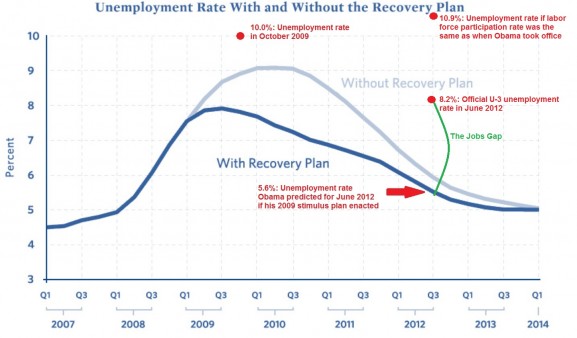
But, don’t forget, Obama predicted 5.6% unemployment by this time with the stimulus
AEI Obama Stimulus
There’s not much else to say here….add your commentary below!
Alan Krueger, Chairman Of the Council of Economic Advisors, soothed Americans on his White House blog post regarding the unemployment numbers released today.
As the Administration stresses every month, the monthly employment and unemployment figures can be volatile, and employment estimates can be subject to substantial revision. Therefore, it is important not to read too much into any one monthly report and it is informative to consider each report in the context of other data that are becoming available
June 2012: “Therefore, it is important not to read too much into any one monthly report and it is informative to consider each report in the context of other data that are becoming available.”
And the month before?
May 2012: “Therefore, it is important not to read too much into any one monthly report and it is helpful to consider each report in the context of other data that are becoming available.”
April 2012: “Therefore, it is important not to read too much into any one monthly report and it is helpful to consider each report in the context of other data that are becoming available.”
And so forth. Like a parrot.
March 2012: “Therefore, it is important not to read too much into any one monthly report, and it is helpful to consider each report in the
context of other data that are becoming available.”
February 2012: “Therefore, as the Administration always stresses, it is important not to read too much into any one monthly report; nevertheless, the trend in job market indicators over recent months is an encouraging sign.”
January 2012: “Therefore, as the Administration always stresses, it is important not to read too much into any one monthly report; nevertheless, the trend in job market indicators over recent months is an encouraging sign.”
December 2011: “Therefore, as the Administration always stresses, it is important not to read too much into any one monthly report.”
November 2011: “Therefore, as the Administration always stresses, it is important not to read too much into any one monthly report.”
October 2011: “The monthly employment and unemployment numbers are volatile and employment estimates are subject to substantial revision. There is no better example than August’s jobs figure, which was initially reported at zero and in the latest revision increased to 104,000. This illustrates why the Administration always stresses it is important not to read too much into any one monthly report.”
September 2011: “Therefore, as the Administration always stresses, it is important not to read too much into any one monthly report.”
August 2011: “Therefore, as the Administration always stresses, it is important not to read too much into any one monthly report.”
July 2011: “Therefore, as the Administration always stresses, it is important not to read too much into any one monthly report.”
June 2011: “Therefore, as the Administration always stresses, it is important not to read too much into any one monthly report.”
May 2011: “Therefore, as the Administration always stresses, it is important not to read too much into any one monthly report.”
April 2011: “Therefore, as the Administration always stresses, it is important not to read too much into any one monthly report.”
March 2011: “Therefore, as the Administration always stresses, it is important not to read too much into any one monthly report.”
February 2011: “Therefore, as the Administration always stresses, it is important not to read too much into any one monthly report.”
January 2011: “Therefore, as the Administration always stresses, it is important not to read too much into any one monthly report.”
December 2010: “Therefore, as the Administration always stresses, it is important not to read too much into any one monthly report.”
November 2010: “Therefore, as the Administration always stresses, it is important not to read too much into any one monthly report.”
October 2010: “Given the volatility in monthly employment and unemployment data, it is important not to read too much into any one monthly report.”
September 2010: “Given the volatility in the monthly employment and unemployment data, it is important not to read too much into any one monthly report.”
August 2010: “Therefore, it is important not to read too much into any one monthly report, positive or negative.”
July 2010: “Therefore, it is important not to read too much into any one monthly report, positive or negative. It is essential that we continue our efforts to move in the right direction and replace job losses with robust job gains.”
June 2010: “As always, it is important not to read too much into any one monthly report, positive or negative.”
May 2010: “As always, it is important not to read too much into any one monthly report, positive or negative.”
April 2010: “Therefore, it is important not to read too much into any one monthly report, positive or negative.”
March 2010: “Therefore, it is important not to read too much into any one monthly report, positive or negative.”
January 2010: “Therefore, it is important not to read too much into any one monthly report, positive or negative.”
November 2009: “Therefore, it is important not to read too much into any one monthly report, positive or negative.”
Parrots repeat the same thing over and over ad nauseum. But they can’t read. Maybe the White House figures that people won’t really read their blog too closely either. Isn’t the definition of insanity is to do the same thing over and over and expecting different results?